

Hot-chamber die casting: definition, principle, and advantages
Abstract:
Hot-chamber die casting is the standard process for manufacturing technical parts made of zinc alloy. Although it is precise, rhythmic, and cost-effective for large production runs, it remains little known to buyers and engineers who are encountering it for the first time. Here is a comprehensive explanation of the process—from its physical principles to its areas of application—to help you understand why this process stands out as the optimal solution for Zamak parts.
What is die casting? General definition
Die casting, also known as pressure casting, is an industrial manufacturing process that involves injecting molten metal alloy into a steel mold under high pressure. The part is formed by the rapid solidification of the metal within the mold cavity.
This process is used exclusively for non-ferrous alloys: zinc, aluminum, and magnesium. It differs from other casting methods (sand casting, shell casting) in three key ways: a high injection velocity (40 to 50 m/s), pressure maintained throughout the solidification process (70 to 100 MPa), and steel molds that can be reused for hundreds of thousands—or even millions—of cycles.
The result: parts with complex geometries, tight tolerances, and finished surfaces, straight from the press, requiring little or no additional machining.
Hot room vs. cold room: What’s the difference?
This is the first question manufacturers ask when they learn about the process. Both methods are based on the same general principle—injecting metal under pressure into a mold—but differ fundamentally in how the molten metal is fed into the cavity.
The hot-chamber machine
In a hot-chamber machine, the injection mechanism (called a “gooseneck” or gooseneck) is directly immersed in the bath of molten metal, which is kept molten in a furnace adjacent to the press. During each cycle, a piston pushes the molten metal into the swan neck and then through a nozzle until the mold cavity is filled under high pressure.
This principle is only feasible for alloys with a melting point low enough not to damage steel injection molding components—which is precisely the case with zamak, which melts at around 380–420 °C, depending on the grade.
The cold-chamber machine
In contrast, in a cold-chamber machine, the molten metal is loaded manually or automatically into an injection chamber separate from the furnace before each cycle. This isolated circuit is necessary for high-melting-point alloys—aluminum, for example, is injected at around 650–700 °C, a temperature that the components of a hot-chamber system could not withstand.
How Does Hot-Chamber Injection Molding Work? The 5 Steps of the Cycle
A hot-chamber die-casting cycle consists of five distinct phases, which are repeated several hundred to several thousand times per hour, depending on the size and complexity of the part.
- Closing the Mold
The two steel mold halves lock together under high clamping force, measured in metric tons (20 to 330 metric tons in ID Casting’s press fleet). This force withstands the injection pressure without the mold opening. - Metal Injection
The piston descends into the swan neck submerged in the bath of liquid zamak and propels the molten metal through the nozzle, the feed channels, and the gates until the mold cavity is filled in a fraction of a second. - Maintaining Pressure
Once the mold cavity is filled, pressure is maintained while the metal solidifies—a process that takes a few seconds, depending on the thickness of the part. This phase is critical for the part’s density and leak-tightness: it eliminates shrinkage voids and reduces microporosity to near-zero levels. - Opening and Ejection
After the part has completely solidified, the mold opens. Ejectors push the part out of the cavity. The part either falls out or is picked up by a robot. - Lubrication and Relinking
A lubricant is applied to the molds for the next cycle. The residual metal in the channels (sprues, core) is recycled in a closed-loop system—remelted in the holding furnace.
Why is the hot chamber process the natural method for producing zamak?
The combination of zamak and a hot chamber is not a mere industrial coincidence: it stems from the physical and economic compatibility between the alloy’s properties and the process requirements.
An ideal melting point.
At approximately 400 °C, zamak melts well below the degradation threshold of tool steels. The swan neck can remain submerged in the molten metal at all times without deteriorating—a condition that is impossible with aluminum.
Exceptional flow during injection.
Molten zamak is particularly fluid, which allows it to fill complex molds, thin walls as thin as 0.5 mm, and fine details that are unattainable with other alloys or processes.
A built-in oven = stable temperature.
The metal bath, which is maintained at a constant temperature, ensures stable viscosity from one cycle to the next, resulting in very high dimensional repeatability—which is critical in high-volume production.
A fast pace.
With a hot chamber, the cycles are short. For thin, lightweight parts, ID Casting’s modern presses can exceed 1,000 shots per hour. This level of performance is unattainable with a cold chamber.
What are the advantages of hot-chamber die casting?
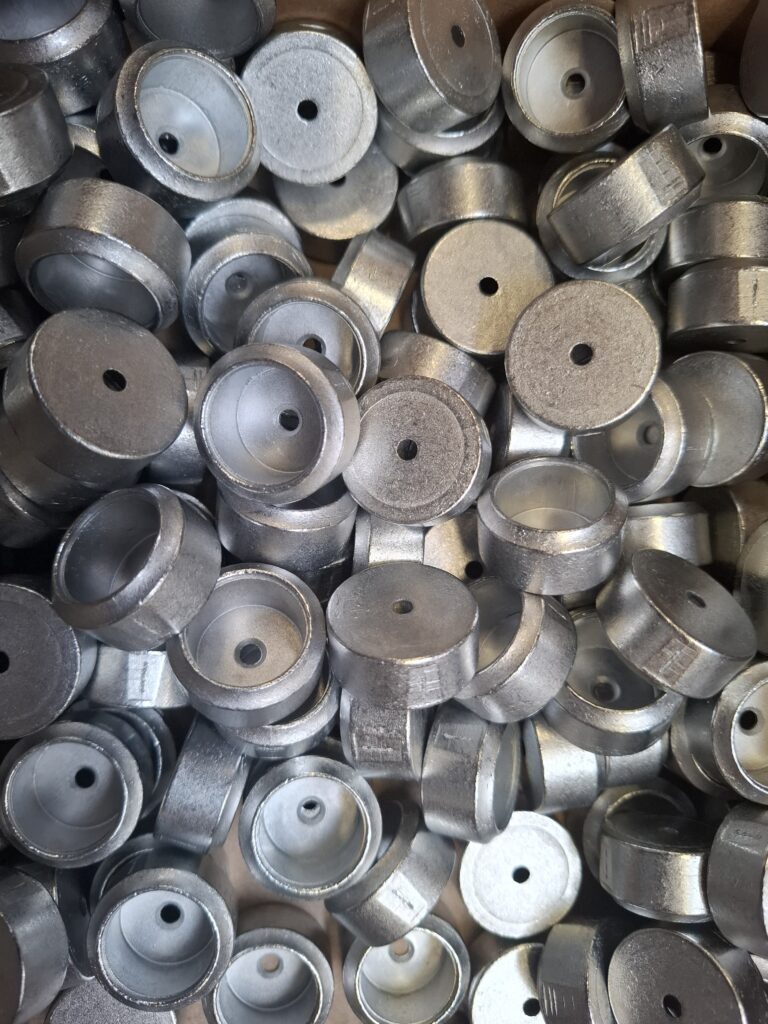
For an engineer or industrial buyer, hot-chamber die casting offers six key advantages:
Dimensional accuracy.
Parts come off the press with tight tolerances, often without the need for secondary machining. Functional dimensions are consistently reproducible throughout the entire production run.
Complex geometries made accessible.
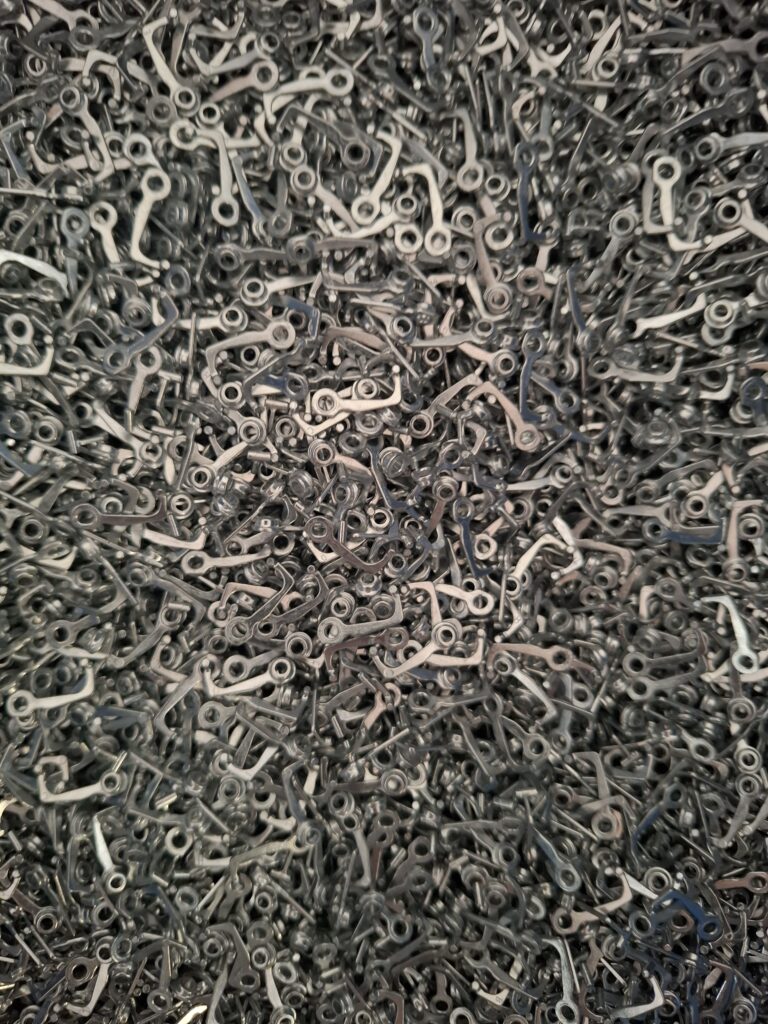
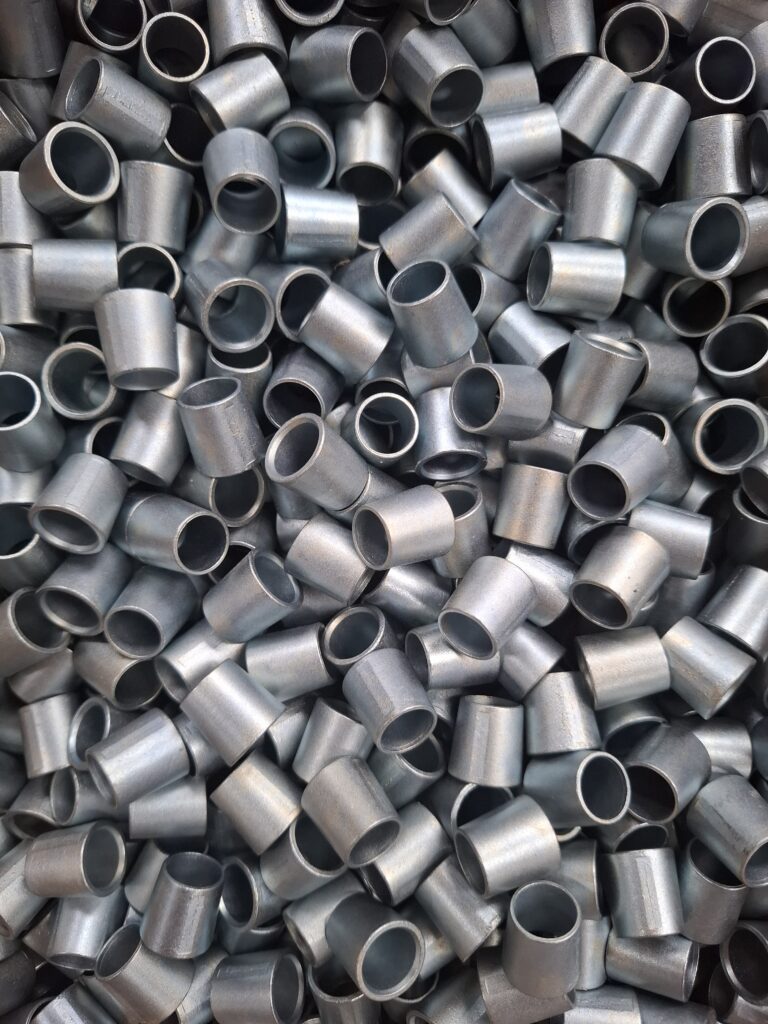
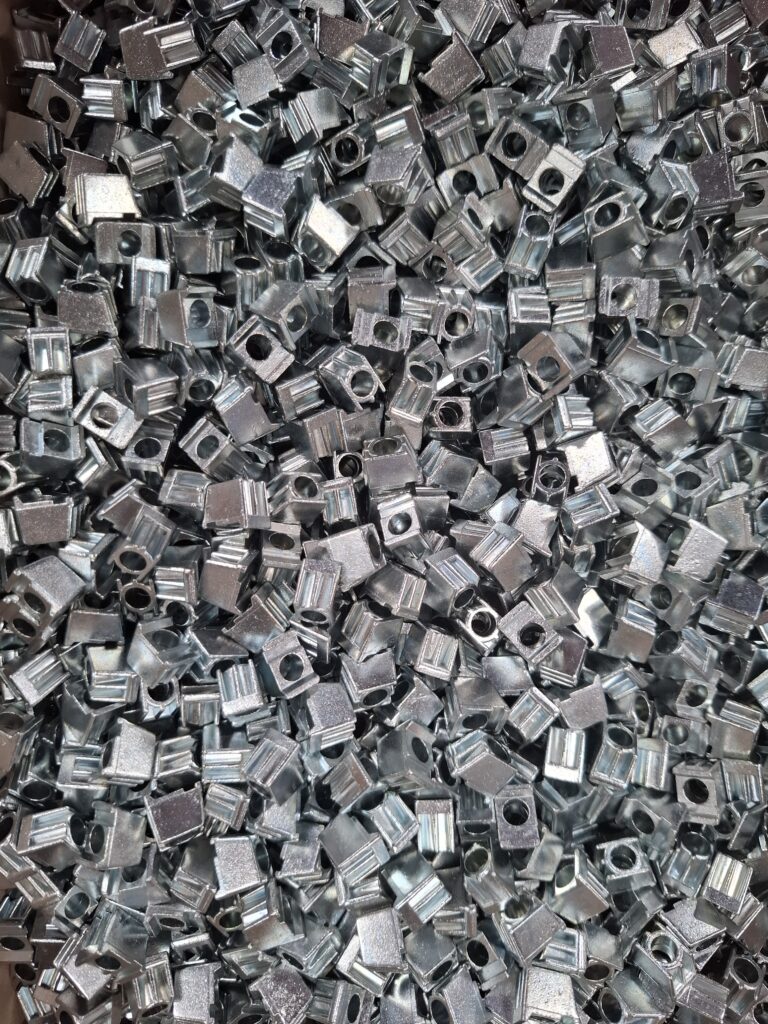
Ribs, clips, inserts, undercuts, threads—the hot-chamber Zamak process allows for shapes that other processes (machining, plastic injection molding, aluminum casting) can hardly achieve or can achieve only at a higher cost.
Natural waterproofing.
The pressure maintained during solidification eliminates internal porosity. Parts produced using the hot-chamber casting process are inherently leak-tight without requiring any additional treatment—a decisive advantage for valve bodies, faucets, or hermetically sealed housings.
Service life of tools.
The moderate injection temperature (~400 °C) helps preserve the molds. At ID Casting, zamak molds regularly exceed one million shots—compared to 100,000 to 300,000 for aluminum molds. For large production runs, this has a significant impact on the unit cost.
Reduced energy costs.
Maintaining a bath at 400 °C consumes significantly less energy than an aluminum furnace at 700 °C. The compact design of the thermal circuit (with the furnace attached to the press) further enhances this advantage.
Productivity and Automation.
The consistency of the process facilitates full automation of the cell: extraction robots, in-line dimensional inspection, and recovery and remelting of sprues. ID Casting operates its 45 zamak presses under high-throughput production conditions at its three sites (Igny, Arbois, Ben Arous).
Which parts are manufactured using hot-chamber die casting?
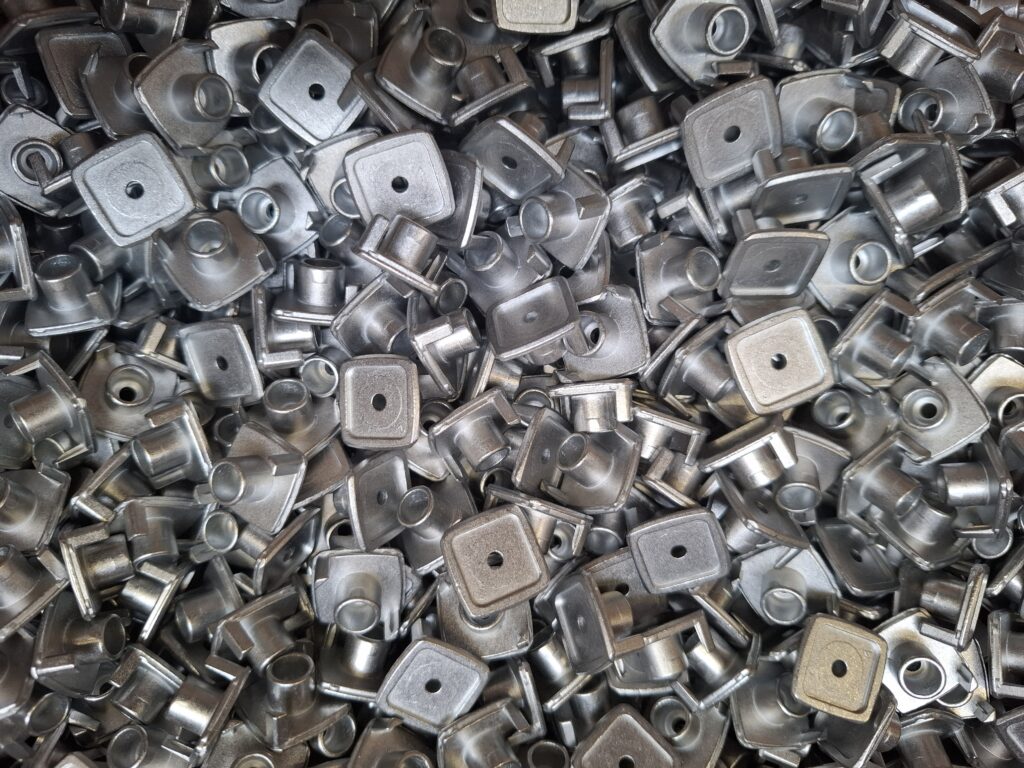
The scope of application is broad, provided the part is made of a zinc alloy and produced in mass production. Among the most common types of parts for ID Casting’s customers are:
Automotive — locks, interior door handles, mounting clips, connector components, sensor housings.
Building & Gas — valve bodies, fittings, valves, technical hardware, gas control components.
Electrical & Electronics — protective enclosures, remote control rings, circuit breaker parts, electromagnetic shielding.
Medical — high-precision components requiring a perfect seal and high repeatability.
Sports & Recreation — assembly parts with high aesthetic and mechanical requirements.
In each of these sectors, the same set of criteria guides the decision to use a zamak hot-chamber die: production volume, required precision, part geometry, and total cost control.
Hot-chamber die casting : What ID Casting Offers Beyond the Process
Mastering the process is a necessary condition, but not a sufficient one. What sets one foundry apart from another is the ability to optimize the part right from the design stage—before the first cut of the milling cutter touches the steel of the mold.
ID Casting supports its clients through co-design: geometry analysis, selection of the Zamak grade, definition of the parting line, filling simulation, and identification of critical areas. The goal is to validate a design that fully leverages the capabilities of the hot-chamber process—and to avoid costly back-and-forth between quotes and tooling requalification.
With more than 200 years of combined experience across its three facilities and 3,000 metric tons of alloy processed annually, ID Casting serves nearly 300 customers in sectors as diverse as the automotive, medical, gas, and electronics industries.
Key Takeaways
Hot-chamber die casting is the natural process for zamak: compatible melting point, high fluidity, durable molds, and high production rates. It differs from cold-chamber casting in that the injection mechanism is permanently immersed in the molten metal bath, which simplifies the thermal circuit and increases productivity. The resulting parts combine dimensional accuracy, inherent leak-tightness, and controlled production costs for large production runs. At ID Casting, this process is at the heart of our expertise, built on more than sixty years of hot-chamber production across three complementary sites.
Do you have a technical part design that needs to be evaluated for Zamak die casting? Contact the ID Casting team for a feasibility analysis and co-design support starting in the design phase.